FRYING PANS - HOW TO CLEAN
FRYING PAN - CLEANING METHODS
A DIRECT COMPARISON
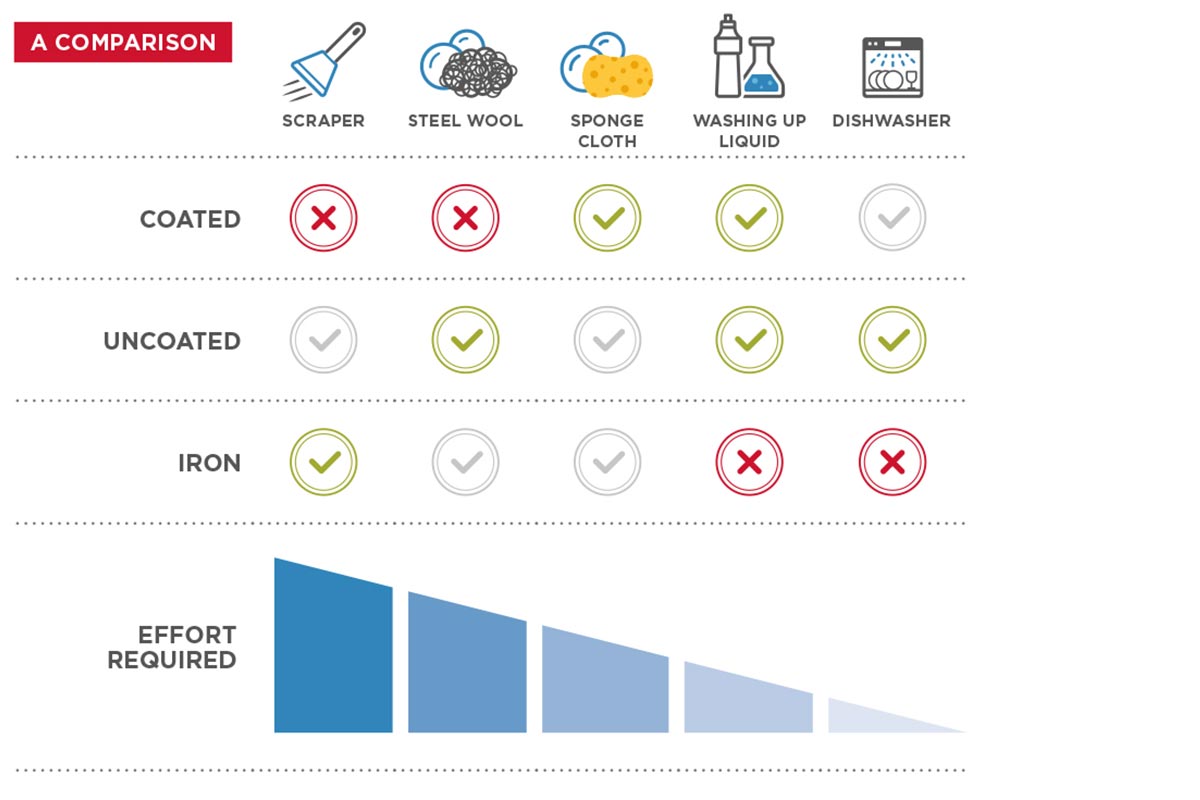
Cleaning a frying pan seems simple enough - mainly because there are so many tips and tricks. Some of them are better than others. However, cleaning frying pans can be more complex than it appears at first glance. Proper cleaning is important because it affects the lifespan of the frying pan. In the chart below, we provide an overview of the cleaning products that are ideal for cleaning a frying pan (green), those that can be used but are not ideal (grey) and those that should not be used under any circumstances (red).
NON-STICK FRYING PANS
The non-stick coating makes cleaning these pans much easier. You need to use less washing-up liquid because food residues hardly stick at all. There is no need to use abrasive, mechanical cleaning tools – in fact, you should avoid them altogether. Excessive mechanical scrubbing will wear away or even damage the coating, causing it to lose its non-stick properties.
UNCOATED STAINLESS STEEL FRYING PANS
These pans are the hardest to clean. As they lack a non-stick coating, burnt-on residues can become firmly stuck and can only be removed with the help of cleaning products and scrubbing. For encrusted deposits, sprinkle the base of the pan with baking powder, pour a little water over it and heat for a short time. After about an hour, the encrusted deposits will come away easily. The cleaner and smoother (without deep scratches) the stainless steel is, the less food will stick to it the next time you use it. This type of pan is dishwasher-safe.
IRON FRYING PANS
Unlike an uncoated stainless steel frying pan, a cast-iron frying pan is susceptible to rust. To prevent rust from forming after cleaning due to any residual moisture, this pan should be seasoned to create a burnt-in patina as a protective layer. When cleaning, care must therefore be taken to ensure that this greasy, water-repellent layer remains intact. For this reason, washing-up liquid or water should not be used to clean a cast-iron pan.